il pleut et j'écoute tomber des petits soleils
Wednesday, April 29, 2009

Saturday, April 25, 2009
an impish dream
an impish dream
The heavy door was locked and students were at the mercy of a wicked school mistress, robed in grey like a nun, yet whose dress combined strange austerity with Victorian lace. She ordered everyone to climb the stairs. I was among the students, yet without feeling I belonged there. The stairwell was made of wood: beautiful carved balustrades, tall columns at each bend, warm wooden paneling with painted motifs high up by the ceiling. There were no windows and I couldn't tell the source of light, yet the stairwell was not dark but bathed in uniform orange light that made the wood seem even warmer. The climb was interminable, and I didn't enjoy the beauty of the carvings or the wooden lacework. Even though I wasn't tired, each step filled me with despair: it would never end. And when it seemed that we might be closer to the top, the stairs would suddenly descend a flight, only to start climbing up again. As if we were trapped in an Escher drawing.
Finally, we reached a landing where a large set of glassed doors swung open. The stairs, however, continued on, and three students kept on climbing, as if in a daze, while the rest of the "class" walked out through the door. I stayed on the landing. I knew that the stairs led into a trap and I needed to rescue the three girls.
Suddenly, one of them tumbled back down. She was Asian and I seemed to know her in the dream, as I did other students, although there were no faces familiar from real life. The girl cowered on the floor and buried her face in her hands. She cried out in a moaning voice, unintelligibly describing the horrors she'd been through, then asked: "How long have I been away?"
"Only a moment," I answered. "No, no," she moaned again, "it's been a hundred years, a hundred years." I noticed a school notebook on the floor next to her. I opened it: it was a diary she kept while away: it was filled cover to cover, and backwards again using any available space.
At that moment, an imp appeared. He was a rather short, perhaps 4ft tall man, with a face that was neither ugly nor handsome, dark hair and a neatly trimmed beard. I do not remember our exact conversation. I made a bargain with him and agreed to go to his world in exchange for the lives of the two other girls. He touched my arm, and the stairwell disappeared. We were now in a painting: a world painted with pastel crayons, in vivid reds and yellows, with visible traits of sketched lines and strokes. The imp was now a devilish character, his face a red mask with lips curved downwards and ending in a small half-spiral in either corner of his mouth. He also had two sets of horns. His appearance didn't make him any more frightening. Rather, there was a sense he merely adapted his looks to the surroundings and by putting on this devilish mask he was playing with his audience's expectations. The two other girls were there, as well. The imp was now very powerful and able to control our bodies. I attempted to reason with him: "You could easily kill us," I said, "but if we're dead, there won't be anyone to admire how powerful you are."
I am not sure whether my argument worked. Suddenly, I was back in the "real world." The imp had been arrested and was now sitting in the back of a police car. In the front, a policeman and a policewoman were asking him questions. The man was trying to convince his partner to be less gentle with their prisoner because it "was the most evil creature that ever lived." The woman, on the other hand, had hard time believing that. The imp wasn't either a man nor a cartoon devil anymore, but a beautiful woman dressed as a prostitute. He easily played with the policewoman's feelings. In a sugared, uncanny cadence, he said: "Oh, now I understand, thank you for rescuing me!"
I wasn't really present at the scene. It was as if I were an omniscient observer: able to see the imp from the front seat of the car, as well as the police car from the outside. Now the car door was pulled shut and I was looking inside through the back passenger window. The imp turned towards me and once more I saw the male face. He smiled slyly and said: "They won't hold me long."
Sunday, April 19, 2009
Wednesday, April 15, 2009
Tuesday, April 07, 2009
dream of tongues
On an ocean shore, or rather, a small bay: one can see both the calm open sea, and what looks like a narrow tongue of sand separating it from the bay. A Wild Girl makes her way across the shallow water, tearing off her clothes. Countless animals, mostly grizzly bears, approach from the other side, trying to reach the mainland. The Girl inadvertently vexes one of the bears, and might have gotten killed if the bear weren't driven by some strange instinct towards the shore. The Girl, however, is utterly unaware of the danger. She reaches the sandy peninsula, naked, and starts running madly across the desert. The dunes are becoming more and more varied. Ephemeral caves appear, hollowed out by the wind, and vanish, buried by the shifting sand. There is one that remains in the landscape suddenly become firm. The cavity is the size of an old hollow oak: two people could easily stand in it. Someone comes and hangs a jar from the ceiling. The glass seems to have been blackened by smoke and the receptacle gives a rather sinister impression. The Girl approaches it with curiosity. At that moment I can see her eyes, but not her whole figure. Inside the jar, asleep, there hangs a small bat. It is visibly growing and its wings are able to extend outside the glass through two narrow slits, previously imperceptible. Yet the animal remains trapped, and I wonder whether it has enough air to breathe, and whether someone will come to its rescue.
In front of the cave, there are dead bodies of a few other bats, still trapped in their jars. I realize that this is some sort of a cruel experiment which intends to test whether a bat is able to learn the human tongue, and which, from the very start, was doomed to fail: that is why there is never anyone to record the results.
The bat awakes. It becomes aware of its prison. Moving with mysterious determination, it perfoms an incredible maneuver: by agitating the jar from within, it manages to roll it along the vertical wall of the cave, and then let it swing back and break against the frame of the cave's entrance.
Outside, there is a tree. In its shade and as if formed of the shadow, the bat, standing erect, much larger now, speaks. Clearly articulated syllables can be heard, there is no doubt about it, for the very first time. It's a new language: beautiful, untamed...
Sunday, April 05, 2009
Ładny dzień (A Nice Day) by Jan Jakub Kolski
How and why certain things make their way into our lives is mysterious. That they come to occupy an important place in it might not perhaps be even as marvelous as the fact that the place had not existed there before, and yet as soon as it had opened up, 'before' ceased to exist.
 You braid silence into your hair. Its whisper opens my dreams.
I know by heart the furrows of your field.

*
*
[Draft. Fragments]
Within the circle of the flame, within the circle of rain, I weep, and I burn.
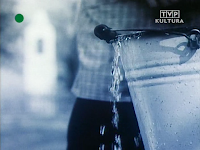
Impossible to stop watching Jan Jakub Kolski's A Nice Day. The 17-minute film is a day-long night-long poem, with an intricate syntax of simple words, image-motifs, monochrome narratives, sound particles... How to write, not on it but in its presence? how to muster enough silence so as not to speak in its stead? To write, perhaps, as one laughs, or weeps. The way one waits.
...the tear of love and forgiveness sweet,
And submission to death beneath his feet;
The tear shall melt the sword of steel,
And every wound it has made shall heal.
And submission to death beneath his feet;
The tear shall melt the sword of steel,
And every wound it has made shall heal.
(William Blake, The Grey Monk)
[Draft. Fragments]
Within the circle of the flame, within the circle of rain, I weep, and I burn.

Your face guards the trace of every tear. My eyes caress the sacred script.
My breast swells in the wake of your plow: fragrant earthfolds.
 You draw liquid darkness in your pail, and pour pearling light over my flesh.
Rye grains in your pocket rattling softly like pennies. In your hands, they turn into birds.My breast swells in the wake of your plow: fragrant earthfolds.


I know by heart the furrows of your field.

Z podziękowaniami dla T. za ładny dzień
Tuesday, March 10, 2009
Films by Peter Hutton (Cinéma du réel, Centre Pompidou)
(1)
"The world within reach": these words, uttered by Gaston Méliès in reference to the movie camera, are carved onto a little plastic plaque attached to Peter Hutton's camera. They are synonymous with another phrase: "to inhabit the world poetically." The poetic camera is not a "window onto the world"; it doesn't open onto the foreign, the unfamiliar, onto a promise of exotic variety amidst quotidian tediousness. The world within reach is just that: what of the world is within one's reach. In French, Gaston Méliès might have said, perhaps, "le monde à la portée de la main." Yet it is not the hand that reaches. The hand grabs. The hand connects the world and the mouth.
Reaching the world, yet abandoning touch to the realm of desire, rending desire for that world within reach, the camera, always fixed, embraces a world fragment, as arbitrary as life, and records its ephemeral form.
Elect a passing thought as your abode. A small patch of sunlight traveling across the mountain slope, now swelling into an outcry of color. The bleached façade of a house risks being splintered in the blaze. A white pang. The wind patches the cloud.
(2)
The image is silent. It is not a pure or an essential image. Merely an image within reach. A world apart from words. Where words remember, the image forgets. Imagines forgetting. You who are looking at it, forget already. Forget yourself in the image.
Great distance and great proximity free objects of their contours. Forgotten, un-named, they forge the image.
Electric flickers, shards of moonlight, shivering screen of muddy water. Nothing else.
The gesture of a grey hull suspended in grey haze: a steel deck, the tip of a mast, adrift in white noise. Or yet: the dark wall of the woods, separating twilight and the river, grazed by a silver gleam: the advance of a prow without a ship.
The image is silent and nearly still. Movement reduced to slight oscillation, to a momentary intervention, or to a faint transition in mood, takes film to the limit of photography.
(3)
Peter Hutton said, half-jokingly: "Feel free to fall asleep during the screening. My films are kind of made for sleeping. I might fall asleep myself."
Contemplation of the film image puts one in a state of reverie, its intensity akin to the alertness experienced in a dream; on the verge of falling asleep, yet as if from within the dream, where slipping into unconsciousness would be to awake, unsure of the direction of the passage.
What does the image dream about?
The camera transforms the world fragment into a dream image. In that sense, it is not a document, mindful of the historical context it hopes to expose or subvert. The image possesses its own temporality that is the loss of any sense of time. Timelessness of the ephemeral.
(4)
Silent, the image ceases to be a representation of the world. It is what it imagines. Silent, the viewer becomes absorbed in the image the way one gets lost in one’s thoughts. In the darkness of the movie theater, you are turned inside out like a glove. The image of your thoughts, which are not yours, only clouds, passing, unwritten. Blank thoughts, grey thoughts, forgotten even before they are formulated. Entirely image. The cinema within. The within outside.
Cease naming things. The sky below the rugged crest, the sea above the fog, the island beneath its shadow. Passage from grey-blue to black-grey to green-white and black. Grain, rock, vapor, mist, sand. Brushed, smudged, torn. Granite tattered by the sky’s edge. Land ruffled by the wind. Clouds folded and solidified in twilight.
"The world within reach": these words, uttered by Gaston Méliès in reference to the movie camera, are carved onto a little plastic plaque attached to Peter Hutton's camera. They are synonymous with another phrase: "to inhabit the world poetically." The poetic camera is not a "window onto the world"; it doesn't open onto the foreign, the unfamiliar, onto a promise of exotic variety amidst quotidian tediousness. The world within reach is just that: what of the world is within one's reach. In French, Gaston Méliès might have said, perhaps, "le monde à la portée de la main." Yet it is not the hand that reaches. The hand grabs. The hand connects the world and the mouth.
Reaching the world, yet abandoning touch to the realm of desire, rending desire for that world within reach, the camera, always fixed, embraces a world fragment, as arbitrary as life, and records its ephemeral form.
Elect a passing thought as your abode. A small patch of sunlight traveling across the mountain slope, now swelling into an outcry of color. The bleached façade of a house risks being splintered in the blaze. A white pang. The wind patches the cloud.
(2)
The image is silent. It is not a pure or an essential image. Merely an image within reach. A world apart from words. Where words remember, the image forgets. Imagines forgetting. You who are looking at it, forget already. Forget yourself in the image.
Great distance and great proximity free objects of their contours. Forgotten, un-named, they forge the image.
Electric flickers, shards of moonlight, shivering screen of muddy water. Nothing else.
The gesture of a grey hull suspended in grey haze: a steel deck, the tip of a mast, adrift in white noise. Or yet: the dark wall of the woods, separating twilight and the river, grazed by a silver gleam: the advance of a prow without a ship.
The image is silent and nearly still. Movement reduced to slight oscillation, to a momentary intervention, or to a faint transition in mood, takes film to the limit of photography.
(3)
Peter Hutton said, half-jokingly: "Feel free to fall asleep during the screening. My films are kind of made for sleeping. I might fall asleep myself."
Contemplation of the film image puts one in a state of reverie, its intensity akin to the alertness experienced in a dream; on the verge of falling asleep, yet as if from within the dream, where slipping into unconsciousness would be to awake, unsure of the direction of the passage.
What does the image dream about?
The camera transforms the world fragment into a dream image. In that sense, it is not a document, mindful of the historical context it hopes to expose or subvert. The image possesses its own temporality that is the loss of any sense of time. Timelessness of the ephemeral.
(4)
Silent, the image ceases to be a representation of the world. It is what it imagines. Silent, the viewer becomes absorbed in the image the way one gets lost in one’s thoughts. In the darkness of the movie theater, you are turned inside out like a glove. The image of your thoughts, which are not yours, only clouds, passing, unwritten. Blank thoughts, grey thoughts, forgotten even before they are formulated. Entirely image. The cinema within. The within outside.
Cease naming things. The sky below the rugged crest, the sea above the fog, the island beneath its shadow. Passage from grey-blue to black-grey to green-white and black. Grain, rock, vapor, mist, sand. Brushed, smudged, torn. Granite tattered by the sky’s edge. Land ruffled by the wind. Clouds folded and solidified in twilight.
Subscribe to:
Posts (Atom)